

Care · Genetics
The SON Gene
A single gene on chromosome 21 controls a process essential to every cell in the body. When one copy doesn't work, the result is ZTTK syndrome. Understanding how SONfunctions — and how it fails — is the first step toward treatments.
What Does SON Do?
The SON gene encodes an RNA-binding protein that plays a central role in pre-mRNA splicing — the molecular process by which non-coding segments (introns) are removed from newly transcribed RNA, and coding segments (exons) are joined together to form mature messenger RNA. This is a required step before genetic instructions can be translated into functional proteins.
SON is particularly critical for handling “weak” splice sites — locations in the RNA sequence where the splicing signals are ambiguous. Without adequate SON protein, the cell's splicing machinery cannot accurately process these sites, leading to incorrectly spliced or missing transcripts for hundreds of downstream genes.
Beyond splicing, SON is essential for the formation of nuclear speckles — subnuclear compartments where splicing factors are stored and organized. SON and SRRM2 together form the structural core of these speckles. When SON is reduced, nuclear speckle architecture is disrupted, broadly impairing RNA processing and gene regulation.
Dr. Erin Ahn's laboratory at the University of Alabama at Birmingham has studiedSON for over 15 years, first in the context of cancer biology and more recently as the cause of ZTTK syndrome. This deep expertise drives the Foundation's translational research strategy.
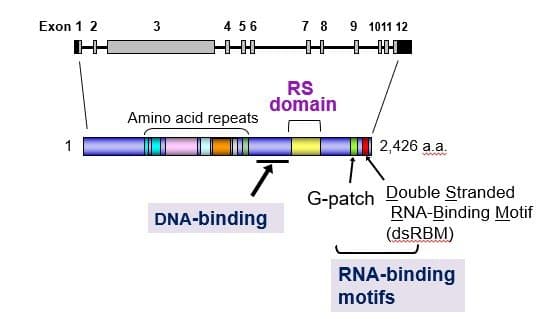
Structure of the SON gene and its protein. The gene's 12 exons (top) encode a 2,426-amino-acid protein (bottom) whose domains let SON bind DNA and RNA and coordinate splicing. Most ZTTK-causing variants cluster in the large exon 3.
Image credit: Ahn Lab, University of Alabama at Birmingham
How SON Variants Cause Disease
Four interconnected molecular mechanisms explain how a single gene disruption produces the broad, multisystem presentation of ZTTK syndrome.
Haploinsufficiency
Humans carry two copies of the SON gene. ZTTK syndrome occurs when one copy is non-functional — a state called haploinsufficiency, meaning "insufficient by half." The remaining working copy cannot produce enough SON protein to sustain normal cellular processes.
Most pathogenic variants are truncating variants (frameshift or nonsense) that trigger nonsense-mediated mRNA decay. The broken copy is destroyed before it can produce protein, leaving only one functional allele.
Disrupted RNA Splicing
The SON protein is a key regulator of pre-mRNA splicing — the process that removes introns and joins exons to produce mature messenger RNA. SON is particularly important for splicing at "weak" splice sites, where the sequence signals are ambiguous and require additional protein support.
When SON levels are reduced, hundreds of splicing events across the genome are affected. Eleven genes essential for brain development and cellular metabolism have been identified as affected so far; full RNA-sequencing in patient cells — currently underway — will show the true extent of these downstream effects.
Impact on Neurodevelopment
The developing central nervous system is exquisitely sensitive to SON protein levels. SON is ubiquitously expressed across all human tissues, but the brain requires very precise gene regulation. Brain involvement is one of the only ubiquitous presentations in ZTTK syndrome.
SON is also essential for nuclear speckle formation, which are subnuclear structures involved in mRNA processing, storage, and export. Disrupted nuclear speckles alter gene expression patterns critical for neuronal differentiation and migration.
Downstream Protein Effects
Beyond splicing, SON participates in cell cycle regulation, cilia formation, and transcriptional control. Reduced SON levels produce changes in cell morphology, defective microtubule dynamics, and impaired centriole assembly — processes fundamental to how cells divide and organize.
SON also inhibits transcription through interaction with the menin protein complex and represses histone H3K4 trimethylation, linking it to epigenetic regulation. Impaired ciliogenesis may explain some of the organ-specific features seen in ZTTK syndrome.
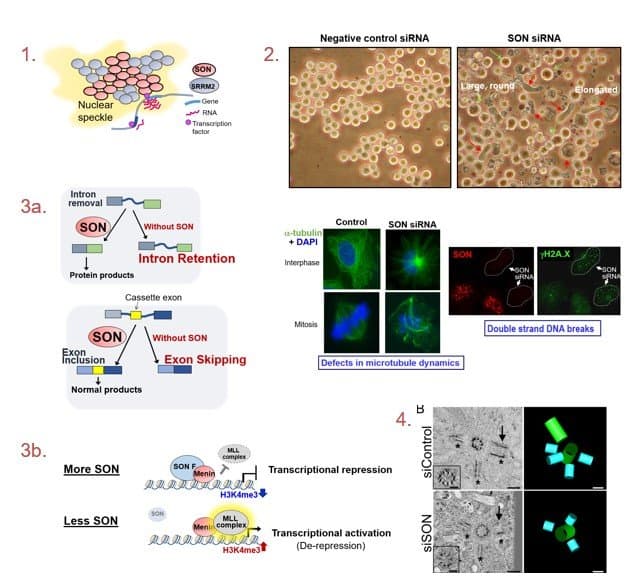
SON's roles inside the cell, from the laboratory. Nuclear speckle formation with SRRM2 (1), altered cell shape and division when SON is reduced (2), intron retention and exon skipping (3a), transcriptional control through the menin–MLL complex (3b), and defective centriole and cilia assembly (4).
Image credit: Ahn Lab, University of Alabama at Birmingham
Variant Types in ZTTK
The majority of pathogenic SON variants identified to date are truncating variants — frameshift deletions or insertions and nonsense (stop-gain) variants — all of which prevent the production of full-length, functional SON protein.
Many variants cluster on the large exon 3 of the SON gene. Approximately 25% of patients in the published literature share the same four base-pair deletion (c.5753_5756del / p.(V1918Efs*87)), suggesting a variant hotspot at this location. Most other variants are unique to individual families.
A smaller number of missense variants (single amino acid changes) have also been identified. Preliminary evidence suggests that individuals with missense variants may present with a milder phenotype than those with truncating variants, though the dataset remains small and this finding requires further study.
All confirmed ZTTK-causing variants follow an autosomal dominant inheritance pattern. The vast majority are de novo — arising spontaneously in the affected child and not inherited from either parent.
Key Publications
The scientific foundation for understanding SON and ZTTK syndrome, from discovery through current preclinical research.
- 1De Novo Mutations in SON Disrupt RNA Splicing of Genes Essential for Brain Development and Metabolism, Causing an Intellectual-Disability Syndrome
Kim JH, Shinde DN, Reijnders MRF, et al. (2016). American Journal of Human Genetics.
Discovery paper establishing SON variants as the molecular cause of ZTTK syndrome
- 2Establishing the phenotypic spectrum of ZTTK syndrome by analysis of 52 individuals with variants in SON
Dingemans AJM, Truong B, van de Lugt L, et al. (2022). European Journal of Human Genetics.
The most comprehensive phenotypic dataset to date — 52 patients with genotype-phenotype analysis
- 3The SON RNA splicing factor is required for intracellular trafficking structures that promote centriole assembly and ciliogenesis
Wolf A, Mertens G, de Leeuw N, et al. (2021). Molecular Biology of the Cell.
Establishes a connection between SON and cilia formation — potential therapeutic pathway
- 4A mouse model of Zhu-Tokita-Takenouchi-Kim syndrome reveals indispensable SON functions in organ development and hematopoiesis
Vukadin L, Kim JH, Park EY, et al. (2024). JCI Insight.
First haploinsufficient mouse model — demonstrates SON's role across organ systems
Continue Learning
Science Is the Path Forward
Every dollar funds research aimed at understanding the SON gene and developing treatments for ZTTK syndrome.